Cholesterol is one of the most frequently requested blood tests, yet the results are still hard to read: total, HDL, LDL, non-HDL, triglycerides, g/L or mmol/L. The target, for its part, depends on each person's cardiovascular risk. This guide explains what each value measures, which reference points European cardiologists use, where a high LDL comes from and which dietary levers have a measured effect in trials.
Key points
- LDL is the main target: it is recognised as a cause of atherosclerosis, with a risk that rises with the level and the duration of exposure.
- There is no single “normal level”: European guidelines aim for below 3.0mmol/L (1.16g/L) at low risk, and down to below 1.4mmol/L (0.54g/L) at very high risk.
- Around one person in 300 has familial hypercholesterolaemia, which is genetic in origin and often goes undiagnosed.
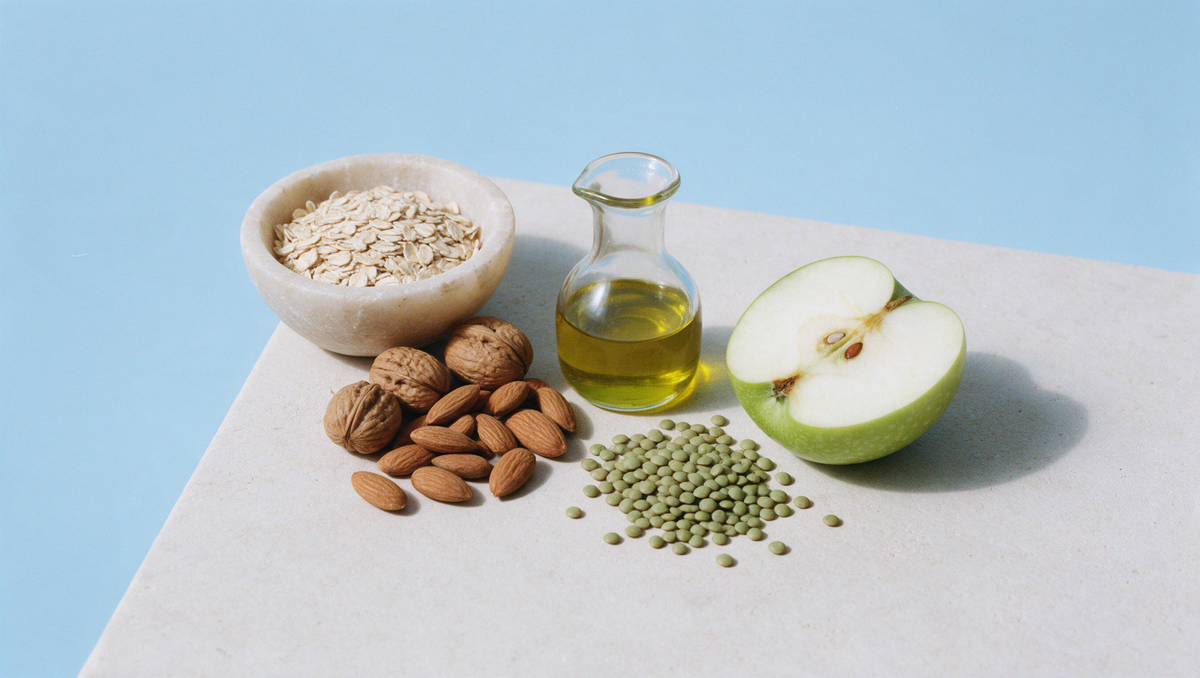
- Replacing saturated fats, adding soluble fibre (oats, psyllium) and eating nuts lowers LDL modestly but measurably.
What is cholesterol and what does it do?
Cholesterol is an essential lipid. It is part of every cell membrane and is the raw material for steroid hormones (cortisol, oestrogens, testosterone), vitamin D and the bile acids that help digest fats. The liver produces most of it; diet supplies only part of the total.
Because it does not dissolve in blood, it travels in particles called lipoproteins, and it is these that the laboratory measures.
Good and bad cholesterol: what do LDL, HDL and non-HDL measure?
“Good” and “bad” are shortcuts: the molecule is the same, only the carrier changes.
- LDL (low-density lipoproteins): these deliver cholesterol to the tissues. In excess, they enter the artery wall, build up there and can become oxidised, a process linked to oxidative stress. A consensus statement from the European Atherosclerosis Society, based on more than 200 studies and over 2 million participants, concludes that LDL causes atherosclerotic cardiovascular disease, with a dose-dependent relationship that increases with the duration of exposure.
- HDL (high-density lipoproteins): these help return cholesterol to the liver. A low HDL is part of the risk profile, but raising HDL is not, on its own, a treatment target.
- Non-HDL: total cholesterol minus HDL. It covers all the particles that can be deposited in the arteries (LDL, VLDL, remnants).
- Triglycerides: storage fats, sensitive to sugar, alcohol and excess weight.
How do you read a cholesterol test (lipid profile)?
A lipid profile usually includes four values. In France, laboratories report them in g/L, often with the equivalent in mmol/L. For cholesterol, 1mmol/L corresponds to 0.387g/L, and 1g/L to 2.586mmol/L (molar mass of 386.7g/mol).
| Parameter | What it reflects | How to interpret it |
|---|---|---|
| Total cholesterol | All the cholesterol carried in the blood | Of limited value on its own: it adds LDL and HDL together |
| LDL cholesterol | Cholesterol in the particles that are deposited in the arteries | Main target value, to be compared with the goal set according to risk |
| HDL cholesterol | Cholesterol on its way back to the liver | A low HDL is included in the risk calculation |
| Non-HDL | All atherogenic particles | Secondary target, especially if triglycerides are high |
| Triglycerides | Storage fats | Sensitive to diet, alcohol, weight and blood sugar |
Two other markers are appearing more and more often: apolipoprotein B (ApoB), which counts the number of atherogenic particles, and lipoprotein(a), or Lp(a), which is largely determined by genes. The 2019 European guidelines suggest measuring Lp(a) at least once in a lifetime, and the 2025 update considers a value above 50mg/dL (105nmol/L) a factor that increases risk.
What LDL cholesterol level should you aim for, depending on your risk?
The guidelines of the European Society of Cardiology and the European Atherosclerosis Society (ESC/EAS 2019, targets unchanged in the 2025 update) set the LDL target according to the level of cardiovascular risk. The doctor assesses this level (age, smoking, blood pressure, diabetes, kidney function, medical history).
| Risk level | LDL target | Secondary non-HDL target |
|---|---|---|
| Low | Below 3.0mmol/L (1.16g/L) | Not specified |
| Moderate | Below 2.6mmol/L (1.00g/L) | Below 3.4mmol/L (1.32g/L) |
| High | Below 1.8mmol/L (0.70g/L) and a reduction of at least 50% | Below 2.6mmol/L (1.00g/L) |
| Very high | Below 1.4mmol/L (0.54g/L) and a reduction of at least 50% | Below 2.2mmol/L (0.85g/L) |
An LDL of 1.5g/L therefore does not mean the same thing at 30 with no risk factors as it does after a heart attack: interpretation is a matter for your GP.
Why does cholesterol go up?
A high LDL often results from several causes that add up.
- Genes. Familial hypercholesterolaemia affects around 1 person in 311 in the general population according to a meta-analysis covering more than 7 million people, and 1 in 17 among patients with atherosclerotic cardiovascular disease. A very high LDL at a young age or early heart events in the family should raise the possibility.
- Diet, in particular a high intake of saturated fats (processed meats, butter, full-fat cheeses, pastries).
- Weight and blood sugar. Excess abdominal fat and insulin resistance mainly raise triglycerides and lower HDL. This profile often goes hand in hand with fatty liver disease.
- The thyroid. Hypothyroidism is accompanied by a rise in total cholesterol, LDL and triglycerides, as thyroid hormones are involved in the liver's clearance of LDL. A thyroid test is often part of the work-up; iodine, which these hormones require, is covered in our article on iodine deficiency.
Which foods really lower LDL cholesterol?
Taken one by one, the measured effects are modest, but these levers can be combined in everyday life.
Cut down on and replace saturated fats
A Cochrane review updated in 2020 (12 trials, 53,758 participants, follow-up of at least 2 years) shows that reducing saturated fats lowers combined cardiovascular events by 17% (RR 0.83), with no clear effect on total mortality and small reductions in total and LDL cholesterol. EU regulation also authorises the following claim for foods high in unsaturated fats: “Replacing saturated fats in the diet with unsaturated fats contributes to the maintenance of normal blood cholesterol levels”. In practice: olive or rapeseed oil rather than butter, pulses and fish rather than processed meats.
Focus on soluble fibre
The beta-glucans in oats and barley form a gel in the gut that traps some of the bile acids. A meta-analysis of 58 trials (3,974 participants, median dose of 3.5g per day) measured an average fall in LDL of 0.19mmol/L. The authorised claim is: “Beta-glucans contribute to the maintenance of normal blood cholesterol levels”, for a food that provides at least 1g of beta-glucans from oats or barley per portion, the effect being obtained with 3g per day. Psyllium, another viscous fibre, lowered LDL by 0.33mmol/L on average in 28 trials (median dose of around 10g per day), with no authorised claim to date.
Add nuts
Across 61 trials (2,582 participants), each daily serving of tree nuts (28g, a small handful of walnuts, almonds or hazelnuts) was associated with an LDL 4.8mg/dL lower, with a clearer effect from 60g per day.
Plant sterols, a targeted lever
Plant sterols and stanols reduce the absorption of cholesterol in the gut. A meta-analysis of 124 studies reports a fall in LDL of 6 to 12% for 0.6 to 3.3g per day, levelling off at around 3g (two of its three authors worked for a company in the sector). The official claim is: “Plant sterols/stanols contribute to the maintenance of normal blood cholesterol levels”, the effect being obtained with at least 0.8g per day.
Weight, exercise, smoking: what effect on your cholesterol results?
A meta-analysis of 73 randomised trials (32,496 participants, follow-up of at least 6 months) estimated that, with lifestyle changes, each kilo lost at 12 months was accompanied by triglycerides 4.0mg/dL lower, an LDL 1.28mg/dL lower and an HDL 0.46mg/dL higher. Weight loss therefore acts mainly on triglycerides and HDL, less on LDL. Physical activity and stopping smoking mainly reduce overall cardiovascular risk.
Red yeast rice, berberine: what to make of supplements?
The 2025 update of the European guidelines does not recommend food supplements or vitamins whose safety and efficacy on LDL have not been documented. Two ingredients come up often in searches.
- Red yeast rice. It contains monacolins, including monacolin K, which is structurally identical to lovastatin, a medicine. In 2018, EFSA expressed a significant safety concern at 10mg per day, reported severe adverse effects from 3mg per day and was unable to identify an intake that carries no risk. Since Regulation (EU) 2022/860, a daily portion must contain less than 3mg of monacolins, with warnings: not during pregnancy or breastfeeding, not under 18 or over 70, and not with a cholesterol-lowering medicine or other products containing red yeast rice.
- Berberine. A meta-analysis of 18 placebo-controlled trials (1,788 participants, 900 to 1,500mg per day for 4 to 24 weeks, 83% conducted in China) measured an average fall in LDL of 0.46mmol/L and in triglycerides of 0.34mmol/L, with digestive complaints slightly more frequent than on placebo. These results relate to the ingredient, and no health claim is authorised for berberine. Its interactions and precautions are covered in our article on berberine.
A supplement never replaces a prescribed treatment, and any combination with a medicine should be discussed with your doctor or pharmacist.
Frequently asked questions
Does high cholesterol cause symptoms?
Generally, no: a high LDL is discovered through a blood test. It is prolonged exposure that damages the arteries, hence the value of regular testing.
Which foods should you avoid with high cholesterol: are eggs one of them?
The American Heart Association concluded in 2020 that observational studies generally do not show a significant link between dietary cholesterol and cardiovascular risk, while high intakes raise LDL in intervention trials. It recommends looking at the diet as a whole (Mediterranean-style) rather than at a single food.
Can high cholesterol be genetic?
Yes. Familial hypercholesterolaemia affects around one person in 300. It shows up as a high LDL from childhood and warrants screening of relatives. Lp(a), which is also inherited, adds to the risk independently of LDL.
How do you convert g/L to mmol/L?
Multiply the value in g/L by 2.586: an LDL of 1.16g/L corresponds to 3.0mmol/L.
How quickly can you lower cholesterol through diet?
The beta-glucan trials lasted at least 3 weeks, those on nuts 3 to 26 weeks. The effects therefore appear within a few weeks, and the doctor decides when to recheck.
Can supplements replace a statin?
No. When a statin is prescribed, it is because the level of risk justifies it. Never stop it without medical advice. The muscle effects reported with statins and the question of coenzyme Q10 should be discussed with the prescriber.
Conclusion
To read a cholesterol test, look first at LDL, then compare it with a personal target set according to cardiovascular risk, not with a single norm. The best-measured levers are simple: fewer saturated fats in favour of unsaturated fats, soluble fibre every day, a handful of nuts, regular activity. Each lowers LDL by a few per cent and they can be combined. Beyond that, it is the doctor who decides on any treatment.
Sources
- Mach F, Baigent C, Catapano AL, et al. 2019 ESC/EAS Guidelines for the management of dyslipidaemias: lipid modification to reduce cardiovascular risk. Eur Heart J. 2020;41(1):111-188. doi:10.1093/eurheartj/ehz455
- Mach F, Koskinas KC, Roeters van Lennep JE, et al. 2025 Focused Update of the 2019 ESC/EAS Guidelines for the management of dyslipidaemias. Eur Heart J. 2025;46(42):4359-4378. doi:10.1093/eurheartj/ehaf190
- Ference BA, Ginsberg HN, Graham I, et al. Low-density lipoproteins cause atherosclerotic cardiovascular disease. 1. Evidence from genetic, epidemiologic, and clinical studies. Eur Heart J. 2017;38(32):2459-2472. doi:10.1093/eurheartj/ehx144
- Hu P, Dharmayat KI, Stevens CAT, et al. Prevalence of familial hypercholesterolemia among the general population and patients with atherosclerotic cardiovascular disease. Circulation. 2020;141(22):1742-1759. doi:10.1161/CIRCULATIONAHA.119.044795
- Hooper L, Martin N, Jimoh OF, et al. Reduction in saturated fat intake for cardiovascular disease. Cochrane Database Syst Rev. 2020;8:CD011737. doi:10.1002/14651858.CD011737.pub3
- Ho HV, Sievenpiper JL, Zurbau A, et al. The effect of oat β-glucan on LDL-cholesterol, non-HDL-cholesterol and apoB for CVD risk reduction: a systematic review and meta-analysis of randomised-controlled trials. Br J Nutr. 2016;116(8):1369-1382. doi:10.1017/S000711451600341X
- Jovanovski E, Yashpal S, Komishon A, et al. Effect of psyllium (Plantago ovata) fiber on LDL cholesterol and alternative lipid targets, non-HDL cholesterol and apolipoprotein B: a systematic review and meta-analysis of randomized controlled trials. Am J Clin Nutr. 2018;108(5):922-932. doi:10.1093/ajcn/nqy115
- Del Gobbo LC, Falk MC, Feldman R, et al. Effects of tree nuts on blood lipids, apolipoproteins, and blood pressure: systematic review, meta-analysis, and dose-response of 61 controlled intervention trials. Am J Clin Nutr. 2015;102(6):1347-1356. doi:10.3945/ajcn.115.110965
- Ras RT, Geleijnse JM, Trautwein EA. LDL-cholesterol-lowering effect of plant sterols and stanols across different dose ranges: a meta-analysis of randomised controlled studies. Br J Nutr. 2014;112(2):214-219. doi:10.1017/S0007114514000750
- Carson JAS, Lichtenstein AH, Anderson CAM, et al. Dietary cholesterol and cardiovascular risk: a science advisory from the American Heart Association. Circulation. 2020;141(3):e39-e53. doi:10.1161/CIR.0000000000000743
- Hasan B, Nayfeh T, Alzuabi M, et al. Weight loss and serum lipids in overweight and obese adults: a systematic review and meta-analysis. J Clin Endocrinol Metab. 2020;105(12):dgaa673. doi:10.1210/clinem/dgaa673
- Liu H, Peng D. Update on dyslipidemia in hypothyroidism: the mechanism of dyslipidemia in hypothyroidism. Endocr Connect. 2022;11(2):e210002. doi:10.1530/EC-21-0002
- EFSA ANS Panel, Younes M, Aggett P, et al. Scientific opinion on the safety of monacolins in red yeast rice. EFSA J. 2018;16(8):5368. doi:10.2903/j.efsa.2018.5368
- Commission Regulation (EU) 2022/860 of 1 June 2022 amending Annex III to Regulation (EC) No 1925/2006 as regards monacolins from red yeast rice. EUR-Lex
- Blais JE, Huang X, Zhao JV. Overall and sex-specific effect of berberine for the treatment of dyslipidemia in adults: a systematic review and meta-analysis of randomized placebo-controlled trials. Drugs. 2023;83(5):403-427. doi:10.1007/s40265-023-01841-4
- Commission Regulation (EU) No 432/2012 of 16 May 2012 establishing a list of permitted health claims made on foods. EUR-Lex
- PubChem. Cholesterol, CID 5997 (molar mass). pubchem.ncbi.nlm.nih.gov
Food supplements are not a substitute for a varied and balanced diet and a healthy lifestyle. Ask a healthcare professional for advice if you are taking medication, are pregnant or are breastfeeding.