
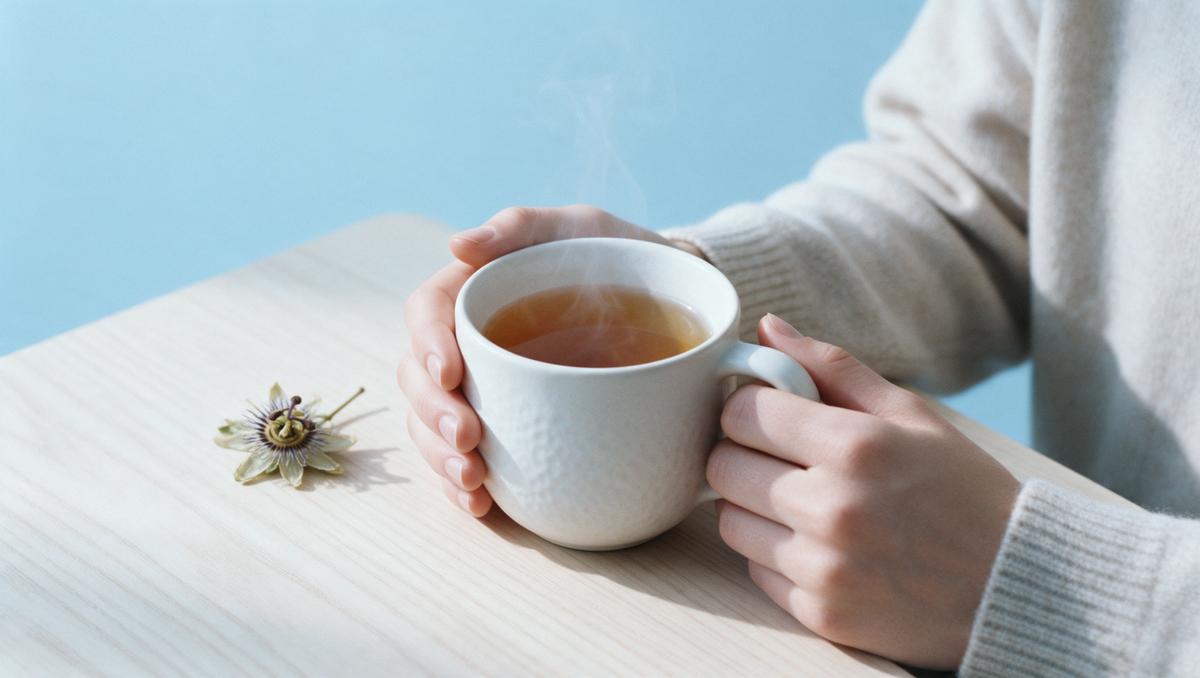
Searching for natural stress relief often leads to lists presenting plants and nutrients as interchangeable. They are not. Some have authorised health claims, others a few encouraging trials, others mainly tradition. This article separates the evidence: what stress is, when to seek care and what studies actually show about commonly cited ingredients, including doses and limitations.
Key takeaways
- Acute stress is useful; its persistence alongside poorer sleep wears the body down.
- Magnesium and B6 are the only ingredients here with authorised claims, concerning psychological function and fatigue.
- L-theanine, rhodiola, saffron and ashwagandha have promising but small, short trials, sometimes manufacturer-funded.
- Physical activity and breathing exercises reduce distress in many trials; lack of sleep raises cortisol.
What is stress from the body's perspective?
Stress is the body's response to a real or perceived threat. It relies on the stress system: the hypothalamus releases CRH, stimulating the pituitary, which directs adrenal glands to secrete cortisol. In parallel, the sympathetic nervous system releases adrenaline and noradrenaline.
This useful response mobilises energy, accelerates the heart and sharpens alertness. A reference review notes that appropriate activity is necessary for well-being and performance. Excessive or insufficient activity may instead promote many mental and physical disorders.
Acute or chronic stress: what is the difference?
Acute stress lasts minutes to hours, then cortisol falls. Chronic stress is repeated activation without enough recovery. Sleep matters greatly: in healthy young men, a shortened night (bed at 4 a.m., rising at 8 a.m.) increased the following evening's cortisol by 37%, and a sleepless night by 45%.
When should stress prompt medical advice?
A food supplement is not an answer to a mental health disorder. Seek care if worry becomes overwhelming and difficult to control most days, panic attacks occur, or sleep, appetite and concentration worsen for weeks. These may indicate anxiety or depression requiring medical care.
Occupational exhaustion also warrants advice. Since 2019, the WHO has described burnout as an occupational phenomenon resulting from unsuccessfully managed chronic workplace stress: exhaustion, mental distance or cynicism towards work, and reduced professional efficacy. In France, if you have suicidal thoughts, 3114 answers free of charge, 24 hours a day.
Magnesium and vitamin B6: what do regulations say?
These are the only two ingredients here with authorised health claims under European Regulation 432/2012. Magnesium “contributes to normal psychological function”, “contributes to the reduction of tiredness and fatigue” and “contributes to normal functioning of the nervous system”. B6 has the same claims and “contributes to the regulation of hormonal activity”.
They describe normal essential nutrient roles, not stress relief effects. They apply regardless of form: bisglycinate, citrate or oxide mainly differ in elemental magnesium and digestive tolerance, as detailed in our comparison of magnesium forms.
What studies show
A 2017 systematic review identified eighteen studies in vulnerable people: mild anxiety, premenstrual syndrome, postpartum or hypertension. Around half reported a favourable effect on perceived anxiety. But authors judged evidence low-quality; none used a validated stress scale.
The most-cited trial followed 264 stressed adults with low blood magnesium for eight weeks: 300mg magnesium daily with or without 30mg B6 (above EFSA's 2023 safety limit of 12mg daily). Stress scores fell 42 to 45% in both groups, without a difference. In the most stressed, B6 addition improved results by a further 24%. Limitations: no placebo group and tested product manufacturer funding. See vitamin B6 roles and sources.
Which other ingredients have been studied?
Beyond these two nutrients, none below has an authorised health claim. The table summarises research measurements and confidence.
| Ingredient | EU status | What was measured | Strength of evidence |
|---|---|---|---|
| Magnesium | Authorised claims | Perceived anxiety, stress | Low |
| Vitamin B6 | Authorised claims | Stress, with magnesium | Limited |
| L-theanine | No claim | Stress, sleep | Preliminary |
| Rhodiola | Traditional medicine (EMA) | Fatigue, performance | Limited |
| Saffron | No claim | Anxiety and depressive symptoms | Promising, possible bias |
| Ashwagandha | No claim | Perceived stress, cortisol | Low despite many trials |
| Passionflower | Traditional medicine (EMA) | Occasional anxiety, sleep | Limited |
L-theanine: the amino acid in tea
L-theanine occurs in tea leaves. In a four-week crossover trial in thirty adults, 200mg daily improved several mood, anxiety and sleep scores from baseline, but only certain sleep components clearly differed from placebo. The study was manufacturer-funded. A nine-trial review concluded 200 to 400mg daily might help in stressful situations, pending longer, larger studies.
Rhodiola: recognised traditional use, limited trials
Rhodiola rosea grows in cold regions. EMA recognises, within traditional herbal medicines, use for “temporary relief of symptoms of stress, such as fatigue and weakness”. Recognition rests on long use, not conclusive trials. An eleven-randomised-trial review found possible physical and mental performance effects, but missing independent replication.
Saffron: marked results still requiring confirmation
Mainly studied in people with depressive or anxiety symptoms, saffron showed large placebo-comparison effects in a twenty-three-trial meta-analysis. Authors identified likely publication bias and little geographical diversity. Findings therefore concern neither everyday stress nor use outside medical care.
Ashwagandha and passionflower: two distinct plants
Ashwagandha and its studied benefits have a dedicated article: the most tested plant for perceived stress, but also the subject of most agency warnings. Passionflower has EMA-recognised traditional use only as herbal medicine (mild stress symptoms, sleep aid); few trials and no supplement claim. Taurine and tryptophan, common in formulas, are not detailed here.
Sleep, sport and breathing: measured approaches
Non-nutritional approaches often have stronger evidence. An overview of 97 reviews covering 1,039 trials and over 128,000 participants shows physical activity reduces depression, anxiety and psychological distress with a medium-sized effect. Higher intensity shows greater benefit.
Breathing exercises have also been tested: twelve trials in 785 adults showed small-to-moderate perceived stress reduction, though most had moderate bias risk. Protecting sleep also limits the cortisol rise above. Our advice for better sleep and understanding melatonin details useful approaches.
How can you read a supplement label accurately?
- Check actual dose: elemental magnesium and B6 quantities, plant extract weight and type.
- Distinguish authorised claims (magnesium, B6) from unauthorised plant promises.
- Avoid layering sedating products and tell your doctor or pharmacist about all supplements.
- Be wary of rapid-effect promises: cited trials lasted four to eight weeks with modest, sometimes fragile results.
Some formulas combine these ingredients, such as Hexagon® Zen complex, with magnesium bisglycinate, passionflower, L-tryptophan, taurine and B6. The same label-reading principles apply to any combination.
Frequently asked questions
What is the strongest natural stress reliever?
No reliable ranking exists: trials use different doses, durations and populations. Ashwagandha has most supplement trials but fragile results and major precautions. Physical activity remains best documented.
Is there an immediately effective natural stress reliever?
Small trials tested single doses (passionflower before a procedure, L-theanine before a stressful situation), but most supplements were evaluated over weeks. For a stress peak, slow breathing is simplest. Sudden intense anxiety with palpitations or chest tightness warrants medical advice.
Can natural stress supplements be taken with antidepressants?
Not without medical advice. Ingredients may enhance sedatives or serotonin medicines, and ashwagandha interacts with several drug classes. Show all ingredients to your doctor or pharmacist.
Are stress-relief plants compatible with pregnancy?
Generally not. Without safety data, EMA recommends neither rhodiola nor passionflower during pregnancy or breastfeeding, and ANSES advises pregnant or breastfeeding women against ashwagandha. Their dedicated articles provide details. Discuss magnesium and B6 with your midwife or doctor according to intake.
Should cortisol be measured to monitor stress?
Not useful for everyday stress. Cortisol varies markedly across the day and between days, so one measurement reveals little. Tests mainly diagnose adrenal diseases on prescription.
How long before judging a supplement's effect?
Cited trials lasted four to eight weeks. Beyond this without clear improvement, consult a professional rather than increasing doses or multiplying products.
Conclusion
No universal natural stress reliever exists. Magnesium and B6 have psychological function and fatigue claims; L-theanine, rhodiola, saffron and ashwagandha have interesting but fragile data. Physical activity, breathing and sleep remain best supported. When stress persists and affects sleep or work, seek a healthcare professional first.
Sources
- Chrousos GP (2009). Stress and disorders of the stress system. Nature Reviews Endocrinology, 5(7), 374-381. doi:10.1038/nrendo.2009.106
- Leproult R et al. (1997). Sleep loss results in an elevation of cortisol levels the next evening. Sleep, 20(10), 865-870. doi:10.1093/sleep/20.10.865
- World Health Organization (2019). Burn-out an "occupational phenomenon": International Classification of Diseases. Press release of 28 May 2019. who.int
- Commission Regulation (EU) No 432/2012 of 16 May 2012 establishing a list of permitted health claims made on foods. Official Journal of the European Union, L 136, 1-40. eur-lex.europa.eu
- Boyle NB, Lawton C, Dye L (2017). The Effects of Magnesium Supplementation on Subjective Anxiety and Stress: A Systematic Review. Nutrients, 9(5), 429. doi:10.3390/nu9050429
- Pouteau E et al. (2018). Superiority of magnesium and vitamin B6 over magnesium alone on severe stress in healthy adults with low magnesemia: A randomized, single-blind clinical trial. PLoS One, 13(12), e0208454. doi:10.1371/journal.pone.0208454
- Hidese S et al. (2019). Effects of L-Theanine Administration on Stress-Related Symptoms and Cognitive Functions in Healthy Adults: A Randomized Controlled Trial. Nutrients, 11(10), 2362. doi:10.3390/nu11102362
- Williams JL et al. (2020). The Effects of Green Tea Amino Acid L-Theanine Consumption on the Ability to Manage Stress and Anxiety Levels: a Systematic Review. Plant Foods for Human Nutrition, 75(1), 12-23. doi:10.1007/s11130-019-00771-5
- Hung SK, Perry R, Ernst E (2011). The effectiveness and efficacy of Rhodiola rosea L.: a systematic review of randomized clinical trials. Phytomedicine, 18(4), 235-244. doi:10.1016/j.phymed.2010.08.014
- European Medicines Agency, HMPC (2024). European Union herbal monograph on Rhodiola rosea L., rhizoma et radix, Final, Revision 1. EMA/HMPC/24177/2023. ema.europa.eu
- Marx W et al. (2019). Effect of saffron supplementation on symptoms of depression and anxiety: a systematic review and meta-analysis. Nutrition Reviews, 77(8), 557-571. doi:10.1093/nutrit/nuz023
- Singh B et al. (2023). Effectiveness of physical activity interventions for improving depression, anxiety and distress: an overview of systematic reviews. British Journal of Sports Medicine, 57(18), 1203-1209. doi:10.1136/bjsports-2022-106195
- Fincham GW et al. (2023). Effect of breathwork on stress and mental health: A meta-analysis of randomised-controlled trials. Scientific Reports, 13, 432. doi:10.1038/s41598-022-27247-y
Food supplements do not replace a varied, balanced diet or a healthy lifestyle. Ask a healthcare professional for advice if you are taking medication, pregnant or breastfeeding.


