You would need to drink around 500 glasses of red wine to consume 150mg resveratrol, the synthetic resveratrol dose assessed as safe by EFSA. This simple calculation captures the misunderstanding surrounding this polyphenol, made famous by the “French paradox” and then striking yeast and mouse studies. Twenty years later, what remains in humans? Actual quantities, bioavailability, the sirtuin controversy, meta-analyses, doses and safety: separating myths from reality.
Key takeaways
- A glass of red wine supplies around 0.3mg resveratrol, 500 times less than the 150mg assessed by EFSA.
- Well absorbed, it is almost entirely transformed by the intestine and liver: the intact form circulates only in traces.
- In humans, meta-analyses show a glucose effect only in people with diabetes, and no clear effect on cholesterol or blood pressure.
- It does not extend life in mice on a normal diet; no human longevity data exist.
What is resveratrol?
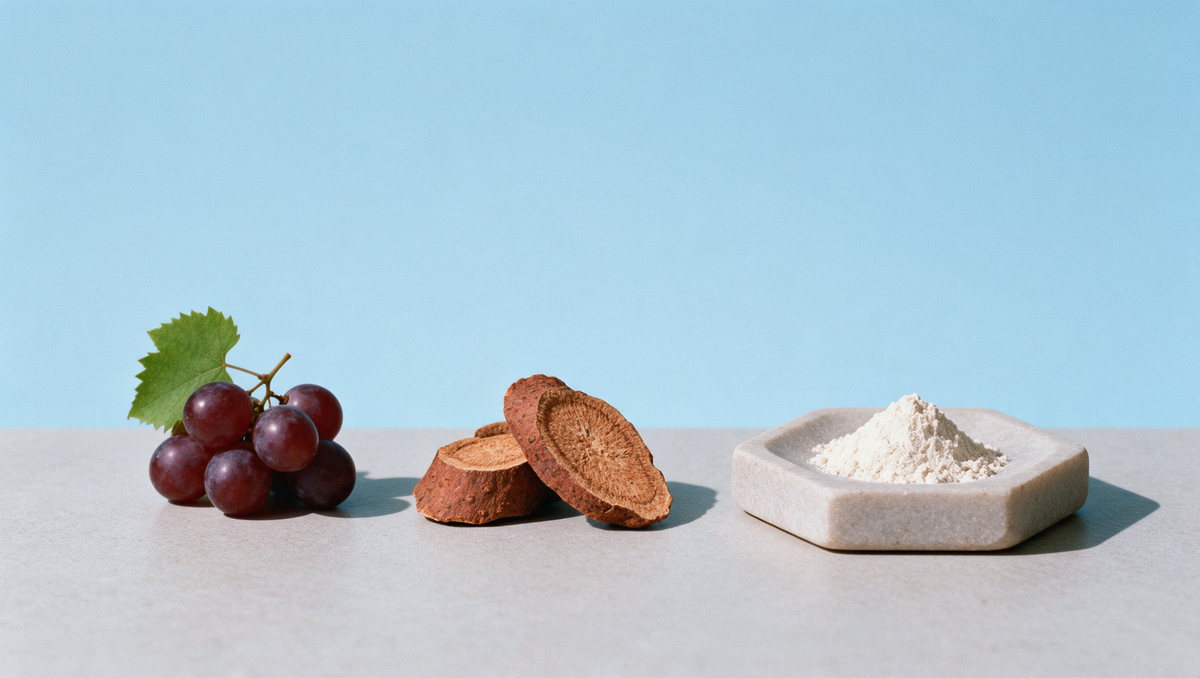
Resveratrol is a polyphenol in the stilbene family. Certain plants make it to defend against infection: it is called a phytoalexin. It is found in red grape skins, red wine and peanuts, always in small quantities.
The trans form is the most studied. Many supplements use Japanese knotweed root extract (Polygonum cuspidatum). Synthetic trans-resveratrol also exists; EFSA assessed it and it was then authorised in the EU as a novel food in 2016.
Myth 1: a glass of red wine supplies a useful dose
Reality: far from it. Red wine contains an average of 1.9mg trans-resveratrol per litre (up to 14mg/L in the richest wines). A 150 ml glass therefore supplies around 0.3mg, or 0.5mg for pinot noir. Clinical trials test tens to thousands of milligrams daily.
Above all, alcohol is not incidental. In 2023, the WHO reiterated that no level of alcohol consumption is risk-free for health. Alcohol has been classified as a proven carcinogen for decades; according to the WHO, it is the alcohol that is harmful, not the beverage. Drinking wine “for resveratrol” therefore makes no sense.
Myth 2: what you swallow reaches cells unchanged
Reality: resveratrol is well absorbed but has very low bioavailability. In a study of six volunteers, at least 70% of a 25mg dose was absorbed. Yet intact resveratrol remained at trace levels in blood (below 5 ng/mL), because the intestine and liver rapidly transform it into sulphated and glucuronidated derivatives.
Even at high single doses (0.5 to 5 g), the intact resveratrol peak remains below concentrations used in many cell studies (above 5 µM). The derivatives might themselves have activity, but this remains unproven. Many effects observed in isolated cells therefore cannot be applied to humans.
Myth 3: it activates “longevity genes”
Reality: this is a genuine scientific controversy. In the early 2000s, studies presented resveratrol as an activator of sirtuins, enzymes associated with ageing in yeast. Sirtuins need NAD+ to function, a molecule discussed in our article on NAD+ and its decline with age.
In 2005, a team showed this activation appeared only with an artificial substrate carrying a fluorescent group. Without it, there was no effect and no yeast lifespan extension in three strains. In 2013, another team described a genuine activation mechanism, but dependent on motifs found only in certain target proteins. The debate remains open. Some resveratrol effects probably involve other pathways, such as AMPK, the cell's “energy sensor”.
Myth 4: it extends lifespan
Reality: not in healthy mammals. In 2006, middle-aged mice on a high-calorie diet lived longer with resveratrol, with improved insulin sensitivity and motor function. This result started the trend.
But in 2011, a large testing programme in three US laboratories using genetically varied mice on a normal diet found no survival effect at two resveratrol doses. In the same experiment, rapamycin extended median lifespan by 10 to 18%. No human study has measured resveratrol's effect on lifespan.
What human meta-analyses show
Human trials are numerous, but often small and short. Their reviews paint a modest picture.
| Area | Result | Evidence |
|---|---|---|
| Blood glucose | Reduction only in people with diabetes | 11 trials, 388 people |
| Blood pressure | No overall effect | 17 trials |
| Cholesterol | No effect | 7 trials, 282 people |
| Inflammation | CRP and TNF-α reduced | 17 trials, 736 people |
| Memory, mood | Inconsistent results | 10 trials |
Blood glucose: an effect only in people with diabetes
A meta-analysis of 11 trials (388 participants) found reduced fasting glucose, insulin, HbA1c and insulin resistance in people with diabetes. In people without diabetes, there was no effect, regardless of dose.
Blood pressure and cholesterol: no clear effect
Across 17 trials, resveratrol did not significantly change blood pressure (−2.5 mmHg systolic, non-significant). A reduction appeared only in subgroups receiving at least 300mg daily or with diabetes. For cholesterol, a meta-analysis of seven trials found no effect on LDL, HDL or triglycerides.
Inflammation and brain: weak signals
In 17 trials (736 participants), CRP and TNF-α, two inflammation markers, decreased slightly, with no interleukin-6 effect. For cognition, of ten trials, three were positive, two mixed and five showed no effect. Authors described the literature as “inconsistent and limited”. Better-studied memory approaches are presented in our article on methods to maintain memory.
Myth 5: combined with exercise, it multiplies benefits
Reality: one trial even suggests the reverse. Twenty-seven sedentary 65-year-old men undertook eight weeks of intensive training with 250mg trans-resveratrol or placebo. Maximum oxygen consumption improved 45% more in the placebo group, and mean blood pressure fell only in that group (−4.8 mmHg).
This is one small trial requiring confirmation. But it reminds us that a molecule does not replace exercise and may even interfere with certain training adaptations.
Which doses have been studied?
Trials tested widely varying doses, from around 10mg to several grams daily depending on the objective. EFSA assessed synthetic trans-resveratrol at the requested dose of 150mg daily in adults and considered it safe under those conditions. Digestive symptoms, particularly diarrhoea, have been reported from 1 g daily.
Side effects and precautions
At common doses, resveratrol is generally well tolerated. Precautions mainly concern interactions and certain situations:
- Medication: according to EFSA, one derivative may inhibit liver enzymes and interact with medicines eliminated by CYP2C9. In theory, high doses could also increase bleeding risk with anticoagulants, antiplatelet drugs and anti-inflammatory medicines.
- Hormone-dependent cancers: women with a history of breast, ovarian or uterine cancer should avoid these supplements as a precaution.
- Pregnancy and breastfeeding: safety is not established, and studies in pregnant rats offer little safety margin.
Frequently asked questions
Which foods contain the most resveratrol?
Red grapes (0.24 to 1.25mg per 160 g), boiled peanuts (0.32 to 1.28mg per 180 g) and red wine (around 0.3mg per glass). These amounts are incomparable with those used in trials.
Trans-resveratrol or resveratrol: what is the difference?
Resveratrol exists as trans and cis forms. Trans is the most studied and the form authorised as a novel food by the EU. On a label, check the trans-resveratrol quantity, not just extract quantity. Hexagon® trans-resveratrol, for example, provides 250mg per capsule, at 98% purity.
Should it be taken with or between meals?
Studies differ: meals have no effect in one, delay absorption without reducing it in another, and a high-fat diet reduces it in a third. No clear rule emerges.
Is resveratrol a good antioxidant?
In a test tube, yes. But in blood, the intact form remains far below laboratory concentrations, and no antioxidant claim is authorised for it. Our own defences, such as glutathione, play a much greater role: see our article on glutathione.
Can it be combined with NAD+ or berberine?
The idea arises from the sirtuin–NAD+ link, but robust trials have not evaluated these combinations. To learn more, read our articles on ways to increase NAD+ and berberine.
Is red wine nevertheless good for the heart?
The “French paradox” long fuelled this idea. But the WHO notes that alcohol risks, particularly cancer, begin at low consumption, and wine supplies a tiny resveratrol dose.
Conclusion
Resveratrol was a major promise in ageing research. Reality is more modest: very low bioavailability, debated sirtuin activation, no lifespan extension in mice on a normal diet, and limited human effects, mainly in diabetes. Red wine is not a useful source. If considering a supplement, look at trans-resveratrol dose and talk to your doctor if you take medication.
Sources
- Linus Pauling Institute, Oregon State University. Resveratrol (Micronutrient Information Center: food contents, bioavailability, safety). lpi.oregonstate.edu
- WHO Europe (2023). No level of alcohol consumption is safe for our health. Press release of 4 January 2023. who.int
- Walle T et al. (2004). High absorption but very low bioavailability of oral resveratrol in humans. Drug Metabolism and Disposition, 32(12), 1377-1382. doi:10.1124/dmd.104.000885
- Kaeberlein M et al. (2005). Substrate-specific activation of sirtuins by resveratrol. Journal of Biological Chemistry, 280(17), 17038-17045. doi:10.1074/jbc.M500655200
- Hubbard BP et al. (2013). Evidence for a common mechanism of SIRT1 regulation by allosteric activators. Science, 339(6124), 1216-1219. doi:10.1126/science.1231097
- Baur JA et al. (2006). Resveratrol improves health and survival of mice on a high-calorie diet. Nature, 444(7117), 337-342. doi:10.1038/nature05354
- Miller RA et al. (2011). Rapamycin, but not resveratrol or simvastatin, extends life span of genetically heterogeneous mice. Journals of Gerontology Series A, 66(2), 191-201. doi:10.1093/gerona/glq178
- Liu K et al. (2014). Effect of resveratrol on glucose control and insulin sensitivity: a meta-analysis of 11 randomized controlled trials. American Journal of Clinical Nutrition, 99(6), 1510-1519. doi:10.3945/ajcn.113.082024
- Fogacci F et al. (2019). Effect of resveratrol on blood pressure: a systematic review and meta-analysis of randomized, controlled, clinical trials. Critical Reviews in Food Science and Nutrition, 59(10), 1605-1618. doi:10.1080/10408398.2017.1422480
- Sahebkar A (2013). Effects of resveratrol supplementation on plasma lipids: a systematic review and meta-analysis of randomized controlled trials. Nutrition Reviews, 71(12), 822-835. doi:10.1111/nure.12081
- Koushki M et al. (2018). Effect of resveratrol supplementation on inflammatory markers: a systematic review and meta-analysis of randomized controlled trials. Clinical Therapeutics, 40(7), 1180-1192. doi:10.1016/j.clinthera.2018.05.015
- Marx W et al. (2018). Effect of resveratrol supplementation on cognitive performance and mood in adults: a systematic literature review and meta-analysis of randomized controlled trials. Nutrition Reviews, 76(6), 432-443. doi:10.1093/nutrit/nuy010
- Gliemann L et al. (2013). Resveratrol blunts the positive effects of exercise training on cardiovascular health in aged men. Journal of Physiology, 591(20), 5047-5059. doi:10.1113/jphysiol.2013.258061
- EFSA NDA Panel (2016). Safety of synthetic trans-resveratrol as a novel food pursuant to Regulation (EC) No 258/97. EFSA Journal, 14(1), 4368. doi:10.2903/j.efsa.2016.4368
Food supplements do not replace a varied, balanced diet or a healthy lifestyle. Ask a healthcare professional for advice if you are taking medication, pregnant or breastfeeding.


