
Vitamin B3 is not a single molecule but a small family: nicotinic acid (often called niacin), nicotinamide and, more recently, nicotinamide riboside (NR). All are used to make NAD+, a coenzyme essential for cellular energy production. Yet they do not behave in the same way: one reddens the skin from a few dozen milligrams, while another is tolerated at much higher doses. Requirements, foods, deficiency, flushing, limits and the role of NR: here are the essentials, according to EFSA, ANSES and studies.
Key takeaways
- Vitamin B3 includes nicotinic acid, nicotinamide and nicotinamide riboside, three NAD+ precursors.
- Adults need around 13 to 17mg of niacin equivalents per day, supplied by food and tryptophan in proteins.
- Nicotinic acid causes flushing around 30 to 50mg; its tolerable upper intake level is 10mg daily, compared with 900mg for nicotinamide.
- Since 2021, nicotinamide riboside chloride has been on the European list of vitamin B3 forms authorised in supplements.
What is vitamin B3?
Vitamin B3 is a water-soluble vitamin. Strictly speaking, niacin describes two molecules, nicotinic acid and nicotinamide, alongside derivatives such as nicotinamide riboside. The body can also make it from an amino acid, tryptophan: around 60mg tryptophan yields 1mg niacin.
This is why requirements are expressed in niacin equivalents (NE): 1mg NE equals 1mg niacin or 60mg tryptophan. As with magnesium (see our comparison of magnesium forms), the chemical form changes many things: here, it mainly determines tolerance.
Vitamin B3 forms at a glance
| Form | Where is it found? | Flushing | Adult limit |
|---|---|---|---|
| Nicotinic acid | Foods, supplements | Yes, around 30 to 50mg | 10mg/day |
| Nicotinamide | Foods, supplements | No | 900mg/day |
| Nicotinamide riboside (NR) | Milk, supplements (as chloride) | Not reported in trials | 300mg/day of chloride (maximum authorised dose) |
What does vitamin B3 do?
All vitamin B3 forms are used to make NAD+ and its phosphorylated variant, NADP+. These coenzymes participate in converting carbohydrates, fats and proteins into energy; NAD+ alternates with its reduced form, NADH, for this purpose (see the difference between NAD+ and NADH). It also serves as a substrate for DNA repair and signalling enzymes, as explained in our article on NAD+ and its roles.
Each form takes a different pathway: nicotinic acid follows the Preiss–Handler pathway, nicotinamide the salvage pathway, NR uses a specific enzyme, NRK, and tryptophan follows a long synthesis pathway. According to a reference review, these distinct pathways explain why each form has its own effects and side effects.
In the EU, niacin has six authorised health claims:
- “Niacin contributes to normal energy-yielding metabolism”;
- “Niacin contributes to normal functioning of the nervous system”;
- “Niacin contributes to normal psychological function”;
- “Niacin contributes to the maintenance of normal mucous membranes”;
- “Niacin contributes to the maintenance of normal skin”;
- “Niacin contributes to the reduction of tiredness and fatigue”.
They are restricted to products providing enough niacin to qualify as a “source” under the regulations.
What are vitamin B3 requirements?
Like EFSA, ANSES sets the adult dietary reference at 1.6mg NE per megajoule of energy consumed, for both men and women. In practical terms, this is around 13 to 17mg NE daily for an intake of 2,000 to 2,500 kcal. On labels, the nutrient reference value (NRV) is 16mg.
Tryptophan in proteins also helps meet these requirements. This amino acid is also used to make serotonin and then melatonin (see our article on sleep and melatonin).
Which foods are rich in vitamin B3?
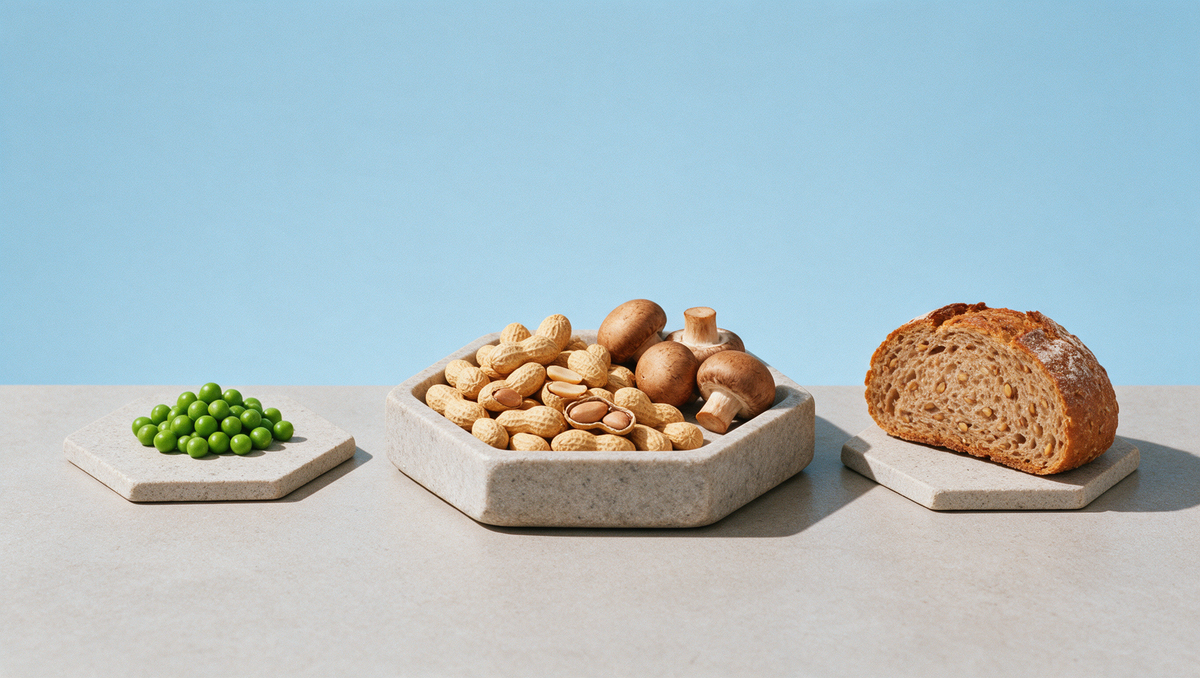
Animal foods are the richest: offal, poultry, fish and meat. Among plant foods, peanuts, whole grains and potatoes provide useful amounts. Here are approximate values published by the US NIH.
| Food | Serving | Niacin | % of NRV |
|---|---|---|---|
| Pan-fried beef liver | 85 g | 14.9mg | 93% |
| Grilled chicken breast | 85 g | 10.3mg | 64% |
| Roast turkey breast | 85 g | 10.0mg | 63% |
| Canned tuna in water, drained | 85 g | 8.6mg | 54% |
| Cooked sockeye salmon | 85 g | 8.6mg | 54% |
| Roast pork tenderloin | 85 g | 6.3mg | 39% |
| Cooked brown rice | 1 cup (240 ml) | 5.2mg | 33% |
| Roasted peanuts | 28 g | 4.2mg | 26% |
| Baked potato | 1 medium | 2.3mg | 14% |
Bioavailability matters: in some cereals, natural niacin is largely bound to complex sugars and only around 30% is absorbed. Corn is an extreme case: its niacin is trapped in a bound form and its proteins are low in tryptophan. In Central America, the traditional practice is to soak it in limewater before making tortillas, releasing that niacin.
Vitamin B3 deficiency: who is affected?
Severe deficiency causes pellagra, described by the “three Ds”: dermatitis, diarrhoea and dementia, to which the WHO adds a fourth, death, without treatment. Skin lesions appear in sun-exposed areas, the tongue may turn bright red, and fatigue, depression or memory problems complete the picture.
Now rare where diets are varied, it remains possible in particular situations:
- malnutrition, particularly associated with alcohol, anorexia, inflammatory bowel disease or cirrhosis;
- a diet based almost entirely on corn;
- rare diseases (Hartnup disease, carcinoid syndrome) and certain tuberculosis treatments such as isoniazid.
Niacin flushing: why nicotinic acid causes redness
Flushing is the characteristic adverse effect of nicotinic acid. From around 30 to 50mg, it causes redness of the face and upper body, with burning, tingling and itching sensations. In the United States, the 35mg daily tolerable upper intake level for supplemental niacin is explicitly based on this effect; in Europe, the limit for nicotinic acid is 10mg daily.
Nicotinamide does not cause flushing. Neither does NR, according to an eight-week trial in 140 adults: no flushing was reported, even at 1,000mg per day. This is one reason why many vitamin B3 supplements use nicotinamide.
What are the safety limits for vitamin B3?
In Europe, the tolerable upper intake levels set in 2002 by the Scientific Committee on Food (SCF), and adopted by EFSA and ANSES, distinguish the forms: 10mg per day for nicotinic acid and 900mg per day for nicotinamide in adults. They are lower in children, for example 2mg nicotinic acid and 150mg nicotinamide between ages one and three.
At pharmacological doses, risks change in scale. Nicotinic acid at 1,000 to 3,000mg daily for months can be toxic to the liver, particularly in sustained-release form. For nicotinamide, signs of liver injury have been described at 3,000mg daily.
These high doses were long used to improve cholesterol before two large trials dampened hopes. In 25,673 adults at high cardiovascular risk already taking a statin, 2 g daily of sustained-release nicotinic acid, combined with a molecule limiting flushing, for around four years did not reduce major vascular events but increased diabetes, digestive problems, bleeding and skin reactions. The AIM-HIGH trial in 3,414 patients had been stopped after three years for lack of benefit.
Nicotinamide riboside: a fully recognised form of vitamin B3?
Yes. NR is a natural form of vitamin B3, found particularly in cow's milk and identified more recently than nicotinic acid and nicotinamide as an NAD+ precursor. It follows its own pathway: conversion into NMN, then NAD+.
Its European status is now clear. Nicotinamide riboside chloride has been authorised as a novel food in supplements since 2020, at a maximum of 300mg daily in adults (230mg in pregnant or breastfeeding women). In 2019, EFSA concluded that it releases bioavailable nicotinamide, and Regulation (EU) 2021/418 added it to the official list of niacin forms alongside nicotinic acid, nicotinamide and inositol hexanicotinate. This is the form used in Hexagon® NAD+ Nicotinamide Riboside Chloride 300mg.
On a molar basis, 300mg NR chloride corresponds to around 126mg nicotinamide: nearly eight times the NRV, but far below the 900mg limit. NR research therefore focuses less on meeting requirements than on changes in NAD+ (see how to act on your NAD+), with clinical results still uncertain. NR has no specific authorised health claim in the EU; its clinical trials and comparison with NMN deserve dedicated articles.
Frequently asked questions
What is another name for vitamin B3?
It is also called vitamin PP, from “pellagra preventive”, referring to pellagra, the disease caused by its deficiency. Niacin is often used for nicotinic acid alone. Nicotinamide and niacinamide are two names for the same molecule.
Is vitamin B6 needed to use vitamin B3 properly?
Vitamin B6 participates in converting tryptophan to niacin, along with vitamin B2 and iron. According to the NIH, low intake of any of these nutrients increases the risk of B3 deficiency. To learn more, see our article on vitamin B6.
Are vegetarians low in vitamin B3?
Not necessarily. Whole grains, peanuts and potatoes provide it, and protein from pulses, eggs or dairy supplies tryptophan that can be converted to niacin. A vegan diet with little variety or few calories requires more attention.
Is niacinamide in creams the same thing?
It is the same molecule as nicotinamide, applied to the skin as a cosmetic ingredient. Its cosmetic effects fall under different regulations and cannot automatically be transferred to oral use, or vice versa.
What does research say about nicotinamide and skin cancers?
In a trial in 386 people with multiple previous non-melanoma skin cancers, 500mg nicotinamide twice daily (1,000mg per day, above the 900mg safety limit) for one year reduced the number of new cancers by 23%, an effect that disappeared after stopping. In 158 organ transplant recipients, the same regimen showed no difference from placebo. This work is medical research, not a basis for self-medication.
Can vitamin B3 be taken during pregnancy?
EFSA applies the same reference to pregnant and breastfeeding women as other adults: 1.6mg NE per megajoule. However, no tolerable upper intake level could be set for these periods because of insufficient data: avoid high doses and ask a healthcare professional before supplementation.
Conclusion
Vitamin B3 comprises several molecules that all lead to NAD+ but differ in tolerance: nicotinic acid causes flushing from a few dozen milligrams and its limit is 10mg daily, compared with 900mg for nicotinamide. A varied diet sufficiently rich in protein supplies both niacin and tryptophan. Nicotinamide riboside is now recognised in the EU as a form of vitamin B3; at 300mg it far exceeds requirements, and research on it focuses on NAD+.
Sources
- EFSA NDA Panel (2014). Scientific Opinion on Dietary Reference Values for niacin. EFSA Journal, 12(7), 3759. doi:10.2903/j.efsa.2014.3759
- ANSES (2025). Nutritional references for vitamins and minerals (vitamin B3). anses.fr
- EFSA (2025). Overview on Tolerable Upper Intake Levels as derived by the Scientific Committee on Food (SCF) and the EFSA Panel on Dietetic Products, Nutrition and Allergies (NDA). efsa.europa.eu
- National Institutes of Health, Office of Dietary Supplements (2022). Niacin – Fact Sheet for Health Professionals. ods.od.nih.gov
- European Commission (2012). Regulation (EU) No 432/2012 of 16 May 2012 establishing a list of permitted health claims made on foods. EUR-Lex
- European Parliament and Council (2011). Regulation (EU) No 1169/2011 on the provision of food information to consumers, Annex XIII (nutrient reference values). EUR-Lex
- European Commission (2021). Regulation (EU) 2021/418 of 9 March 2021 amending Directive 2002/46/EC as regards nicotinamide riboside chloride and magnesium citrate malate used in the manufacture of food supplements. EUR-Lex
- EFSA NDA Panel, Turck D et al. (2019). Safety of nicotinamide riboside chloride as a novel food pursuant to Regulation (EU) 2015/2283 and bioavailability of nicotinamide from this source, in the context of Directive 2002/46/EC. EFSA Journal, 17(8), 5775. doi:10.2903/j.efsa.2019.5775
- Bogan KL, Brenner C (2008). Nicotinic Acid, Nicotinamide, and Nicotinamide Riboside: A Molecular Evaluation of NAD+ Precursor Vitamins in Human Nutrition. Annual Review of Nutrition, 28, 115-130. doi:10.1146/annurev.nutr.28.061807.155443
- Trammell SA et al. (2016). Nicotinamide Riboside Is a Major NAD+ Precursor Vitamin in Cow Milk. The Journal of Nutrition, 146(5), 957-963. doi:10.3945/jn.116.230078
- World Health Organization (2000). Pellagra and its prevention and control in major emergencies. WHO/NHD/00.10. who.int
- Conze D, Brenner C, Kruger CL (2019). Safety and metabolism of nicotinamide riboside chloride taken for 8 weeks: a double-blind randomised placebo-controlled trial in overweight adults (descriptive title). Scientific Reports, 9, 9772. doi:10.1038/s41598-019-46120-z
- Chen AC et al. (2015). A Phase 3 Randomized Trial of Nicotinamide for Skin-Cancer Chemoprevention. New England Journal of Medicine, 373(17), 1618-1626. doi:10.1056/NEJMoa1506197
- Allen NC et al. (2023). Nicotinamide for Skin-Cancer Chemoprevention in Transplant Recipients. New England Journal of Medicine, 388(9), 804-812. doi:10.1056/NEJMoa2203086
Food supplements do not replace a varied, balanced diet or a healthy lifestyle. Ask a healthcare professional for advice if you are taking medication, pregnant or breastfeeding.


