
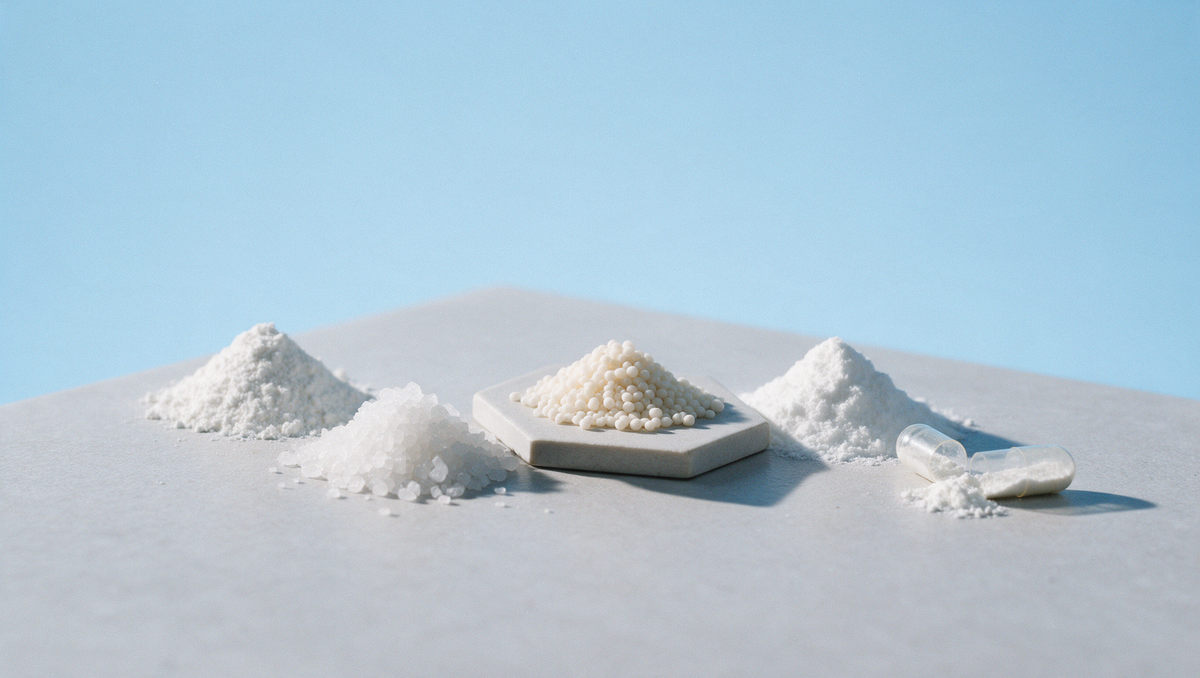
Bisglycinate, citrate, L-threonate, marine magnesium, oxide… In front of a supplement shelf, the same question arises: which magnesium should you choose? The answer has less to do with packaging than with two measurable criteria: the chemical form, which affects absorption and digestive tolerance, and the amount of elemental magnesium actually supplied. Here is a comparison of the main forms, based on available studies, to help you choose for your needs.
Key takeaways
- The chemical form (bisglycinate, citrate, oxide…) affects absorption and digestive tolerance: organic forms are better absorbed than oxide.
- Compare elemental magnesium per dose, not the weight of the salt: 1,000mg of oxide provides around 600mg of magnesium.
- Bisglycinate is among the forms best tolerated by the gut; high doses of citrate and oxide speed up bowel transit.
- ANSES adequate intake values: 380mg per day for adult men, 300mg for women.
Why the form of magnesium makes all the difference
A supplement never contains “pure” magnesium. The mineral is always bound to another molecule: an organic acid (citrate, malate), an amino acid (glycine, taurine) or a mineral compound (oxide, chloride). This partner, called the form or salt, determines three things.
- Elemental magnesium content. 1,000mg of magnesium oxide provides around 600mg of magnesium, compared with around 140mg in 1,000mg of bisglycinate. It is the elemental magnesium amount that should be compared, not the weight of the salt.
- Solubility and absorption. According to the US NIH, aspartate, citrate, lactate and chloride are better absorbed than oxide and sulphate.
- Digestive tolerance. Unabsorbed magnesium retains water in the intestine. This explains the laxative effect of some forms at high doses.
Formulation matters too: in laboratory testing, fifteen commercial supplements dissolved very unevenly, depending on the salt but also the excipients.
How much magnesium do you need per day?
In France, ANSES sets adequate intake at 380mg per day for adult men and 300mg for women. EFSA uses 350 and 300mg. On labels, the nutrient reference value (NRV) is 375mg.
According to the national INCA 3 study, average intake is 382mg per day in men and 303mg in women, in line with these references. But an average conceals differences: eating few whole grains, pulses, nuts and green vegetables, the main sources of magnesium, increases the risk of insufficient intake.
Magnesium contributes, among other things, to reducing tiredness and fatigue, normal energy-yielding metabolism, normal functioning of the nervous system, normal muscle function and normal psychological function. These roles relate to magnesium in general: no individual form has its own authorised claim.
Comparison table of magnesium forms
| Form | Elemental magnesium (approximate) | Absorption and tolerance | Typical use |
|---|---|---|---|
| Bisglycinate (glycinate) | 14% | Good; very well tolerated | Daily use, sleep, sensitive digestion |
| Citrate | 11 to 16% | Good; moderate tolerance, laxative at high doses | Good value, sluggish bowel transit |
| L-threonate | 7 to 8% | Studied for the brain; well tolerated | Memory, concentration, sleep |
| Malate | 15% | Few comparative data; well tolerated | Daily use |
| Taurate | 9% | Few human studies; well tolerated | Combination with taurine |
| Chloride | 12% | Good; moderate tolerance, bitter taste | Powders and solutions |
| Glycerophosphate | 12% | Good; well tolerated | Daily use |
| Oxide, hydroxide (including some “marine” magnesium products) | 42 to 60% | Low; frequent laxative effect | Concentrated, inexpensive supply; bowel transit |
Percentages are approximate values calculated from the chemical formula of each salt; they vary with its degree of hydration.
Magnesium bisglycinate: the gentlest form for the gut
Bisglycinate (also called glycinate) combines one magnesium atom with two molecules of glycine, an amino acid. This “chelated” structure is stable in the digestive tract, explaining its good tolerance: it is the form least frequently associated with loose stools.
Absorption data are more nuanced than often suggested. In 12 patients who had undergone resection of the ileum, the final section of the small intestine, average diglycinate absorption was similar to oxide (23.5% versus 22.8%), but twice as high in those with the poorest absorption, with better tolerance.
For sleep, a randomised trial published in 2025 followed 155 adults reporting poor sleep: 250mg of magnesium as bisglycinate, taken in the evening for four weeks, reduced the insomnia score by 3.9 points, compared with 2.3 with placebo. The effect is real but modest, and the glycine supplied by bisglycinate may itself contribute.
Beware of “buffered” bisglycinate: some products add magnesium oxide to display a higher amount per capsule. Read the ingredient list.
Magnesium citrate: well absorbed, active on bowel transit
In a double-blind randomised trial, 46 adults took 300mg of magnesium per day for 60 days as citrate, an amino acid chelate or oxide. Citrate produced the highest blood magnesium level, and both organic forms increased urinary magnesium more than oxide, which performed no better than placebo. An earlier study had already shown that citrate dissolves in water, whereas oxide remains almost insoluble.
The downside: at high doses, citrate speeds up bowel transit, an advantage in constipation but a drawback if your gut is sensitive.
Magnesium L-threonate: the form studied for the brain
L-threonate combines magnesium with a vitamin C derivative. Developed from work by MIT researchers, it increased magnesium in cerebrospinal fluid and improved memory in rats, whereas other salts tested had no significant effect. Human evidence remains limited:
- in 44 adults aged 50 to 70 reporting memory problems, 12 weeks of L-threonate (1.5 to 2 g per day) improved a global cognitive score compared with placebo;
- in 80 adults reporting poor sleep, 1 g per day for 21 days did not change the insomnia score, but improved deep and REM sleep scores measured by a connected ring, as well as self-reported mood and energy.
Both trials were funded by ingredient manufacturers: encouraging results that require independent confirmation. The trade-off is its low elemental magnesium content, around 7 to 8%. This is the form used in Hexagon® Magtein® 2000mg, which provides 154mg of elemental magnesium in 3 capsules.
Oxide and marine magnesium: concentrated but poorly absorbed
Oxide is the most concentrated form, with around 60% elemental magnesium, but dissolves poorly: around 4% fractional absorption in a comparative study, where chloride, lactate and aspartate performed better. It also causes digestive symptoms more often, making it primarily an inexpensive option for constipation.
As for “marine magnesium”, the term describes an origin, seawater, rather than a chemical form: magnesium extracted from it may be hydroxide or oxide, two poorly soluble forms. What matters is the form stated on the label.
Malate, taurate, chloride and glycerophosphate: other forms
- Malate: bound to malic acid, an intermediate in cellular energy production. Well tolerated, with few comparative data.
- Taurate: bound to taurine, a sulphur-containing amino acid (see the benefits of taurine). Evidence mainly from animals.
- Chloride: soluble and well absorbed, often as powder or solution, but bitter and active on bowel transit.
- Glycerophosphate: well tolerated, less common in mainstream supplements.
Which magnesium should you choose for your needs?
For better sleep
Bisglycinate taken in the evening is the best-supported option in adults, with the 2025 trial described above; L-threonate is an alternative. In older people, a meta-analysis of three trials found sleep onset around 17 minutes faster, with low-quality evidence and oxide doses above the European limit. Find other approaches in our article on disrupted sleep.
During periods of stress
A review of 18 studies concluded that a possible effect exists on mild anxiety and premenstrual symptoms, with low-quality evidence. Combined with vitamin B6, magnesium was no better than magnesium alone in 264 stressed adults (42 to 45% less stress in both groups, with no placebo group), except in the most stressed participants. Other approaches: 5 ingredients studied for stress.
For fatigue
Magnesium contributes to reducing tiredness and fatigue, regardless of its form: choose one you tolerate well enough to take every day, such as bisglycinate or moderate-dose citrate.
For cramps
This is the most common use, and the least supported. A Cochrane review of 11 trials (735 participants) judged it unlikely that magnesium meaningfully reduces muscle cramps in older adults; in pregnant women, results are conflicting. If cramps are frequent, talk to a doctor.
For bowel transit
Citrate or oxide: their effect on transit, inconvenient for other uses, becomes an advantage here.
For memory and concentration
L-threonate is the only form studied for human cognition, with the limitations described above. Sleep, physical activity and diet matter too: see the most effective methods for memory.
What dose, and when should you take it?
For magnesium supplied by supplements, the tolerable upper intake level set in Europe is 250mg per day from age four. It is based on the laxative effect: mild diarrhoea around 360mg per day, none at 250mg. It does not apply to magnesium in foods. Several trials cited here used more: above 250mg, ask a healthcare professional for advice.
- Spread the dose across the day if your gut is sensitive.
- Take it with a meal to limit digestive discomfort.
- In the evening if your goal is sleep: this was the timing used in the 2025 bisglycinate trial.
- Be patient: clinical trials measure effects after 3 to 12 weeks of regular use.
Adverse effects and precautions
Adverse effects are mainly digestive: diarrhoea, nausea and abdominal cramps, more common with oxide, chloride or carbonate. Some precautions are necessary:
- Kidney disease: the kidneys remove excess magnesium. In kidney failure, do not take a supplement without medical advice.
- Antibiotics (tetracyclines, quinolones): take the antibiotic at least 2 hours before or 4 to 6 hours after magnesium.
- Bisphosphonates, prescribed for osteoporosis: separate doses by at least 2 hours.
- Diuretics and proton pump inhibitors taken long term may lower magnesium levels. Discuss this with your doctor.
Frequently asked questions
Are magnesium bisglycinate and glycinate the same?
Yes. Both terms describe the same compound: one magnesium atom bound to two glycine molecules. “Bisglycinate” specifies two glycines, and “chelated” describes the bond type, not a different form.
Which magnesium does not cause diarrhoea?
Bisglycinate, L-threonate and glycerophosphate are best tolerated. However, regardless of form, diarrhoea depends mainly on quantity: this is why the European supplement limit is 250mg per day.
Can you take magnesium every day?
Yes, in healthy adults, staying within the amounts stated on the product. Long-term use at high doses, or in kidney disease, should be discussed with a doctor.
Should you combine magnesium and vitamin B6?
This is a coherent combination: vitamin B6 also contributes to reducing tiredness and fatigue and the normal functioning of the nervous system. To learn more, read 5 things to know about vitamin B6.
How do you read a magnesium supplement label?
Look for three pieces of information: the exact form (bisglycinate, citrate…), the amount of elemental magnesium per daily dose and the percentage of the NRV. Then check the ingredient list for any added oxide.
Is magnesium better absorbed in capsules or tablets?
The chemical form matters far more than the format: see our article on capsule forms and functions.
Conclusion
Choosing magnesium begins with choosing a form: bisglycinate for versatility and tolerance, citrate for good absorption at a low price, L-threonate for memory, oxide for bowel transit. “Marine” only indicates an origin. Always compare elemental magnesium amounts, stay below 250mg per day from supplements unless medically advised otherwise, and assess results after several weeks.
Sources
- ANSES. Nutritional references for vitamins and minerals. anses.fr
- ANSES (2017). Third national individual food consumption study (INCA 3). anses.fr
- EFSA NDA Panel (2015). Scientific Opinion on Dietary Reference Values for magnesium. EFSA Journal, 13(7), 4186. doi:10.2903/j.efsa.2015.4186
- EFSA (2025). Overview on Tolerable Upper Intake Levels as derived by the SCF and the EFSA NDA Panel. efsa.europa.eu
- Regulation (EU) No 432/2012 establishing a list of authorised health claims. eur-lex.europa.eu
- NIH Office of Dietary Supplements (2026). Magnesium – Fact Sheet for Health Professionals. ods.od.nih.gov
- Blancquaert L, Vervaet C, Derave W (2019). Predicting and Testing Bioavailability of Magnesium Supplements. Nutrients, 11(7), 1663. doi:10.3390/nu11071663
- Schuette SA, Lashner BA, Janghorbani M (1994). Bioavailability of magnesium diglycinate vs magnesium oxide in patients with ileal resection. Journal of Parenteral and Enteral Nutrition, 18(5), 430-435. doi:10.1177/0148607194018005430
- Schuster J et al. (2025). Magnesium Bisglycinate Supplementation in Healthy Adults Reporting Poor Sleep: A Randomized, Placebo-Controlled Trial. Nature and Science of Sleep, 17, 2027-2040. doi:10.2147/NSS.S524348
- Walker AF et al. (2003). Mg citrate found more bioavailable than other Mg preparations in a randomised, double-blind study. Magnesium Research, 16(3), 183-191. PubMed 14596323
- Lindberg JS et al. (1990). Magnesium bioavailability from magnesium citrate and magnesium oxide. Journal of the American College of Nutrition, 9(1), 48-55. doi:10.1080/07315724.1990.10720349
- Slutsky I et al. (2010). Enhancement of learning and memory by elevating brain magnesium. Neuron, 65(2), 165-177. doi:10.1016/j.neuron.2009.12.026
- Liu G et al. (2016). Double-blind randomised placebo-controlled trial of a magnesium L-threonate supplement for cognitive impairment in older adults. Journal of Alzheimer's Disease, 49(4), 971-990. doi:10.3233/JAD-150538
- Hausenblas HA et al. (2024). Magnesium-L-threonate improves sleep quality and daytime functioning in adults with self-reported sleep problems: A randomized controlled trial. Sleep Medicine: X, 8, 100121. doi:10.1016/j.sleepx.2024.100121
- Firoz M, Graber M (2001). Bioavailability of US commercial magnesium preparations. Magnesium Research, 14(4), 257-262. PubMed 11794633
- Mah J, Pitre T (2021). Oral magnesium supplementation for insomnia in older adults: a Systematic Review & Meta-Analysis. BMC Complementary Medicine and Therapies, 21(1), 125. doi:10.1186/s12906-021-03297-z
- Boyle NB, Lawton C, Dye L (2017). The Effects of Magnesium Supplementation on Subjective Anxiety and Stress — A Systematic Review. Nutrients, 9(5), 429. doi:10.3390/nu9050429
- Pouteau E et al. (2018). Superiority of magnesium and vitamin B6 over magnesium alone on severe stress in healthy adults with low magnesemia: A randomized, single-blind clinical trial. PLoS One, 13(12), e0208454. doi:10.1371/journal.pone.0208454
- Garrison SR et al. (2020). Magnesium for skeletal muscle cramps. Cochrane Database of Systematic Reviews, 9, CD009402. doi:10.1002/14651858.CD009402.pub3
Food supplements do not replace a varied, balanced diet or a healthy lifestyle. Ask a healthcare professional for advice if you are taking medication, pregnant or breastfeeding.


