
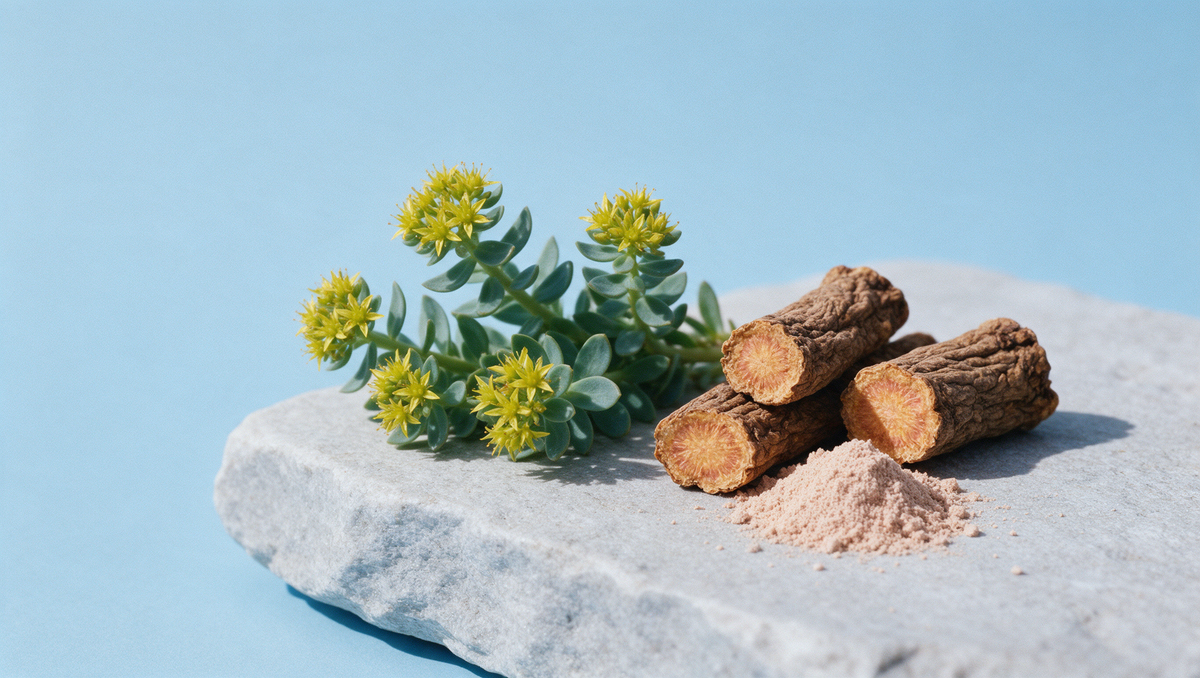
In March 2024, the European Medicines Agency (EMA) revised its assessment of rhodiola, a plant widely searched for in France in connection with fatigue and stress. Its verdict is nuanced: recognised traditional use, but insufficient evidence of clinical efficacy. Here is what trials actually measure, how long they take and the precautions to know.
Key takeaways
- Rhodiola (Rhodiola rosea) grows in cold mountains; extracts are often standardised for rosavins and salidroside, its reference compounds.
- The EMA recognises traditional use for rhodiola medicines (144 to 400mg of extract per day), but considers the clinical evidence insufficient.
- Trials on stress-related fatigue are small, short and contradictory; no health claim is authorised for the plant.
- Reported effects include headache, digestive complaints and insomnia. Caution with antidepressants; not recommended during pregnancy, breastfeeding or under age 18.
What is rhodiola?
Rhodiola (Rhodiola rosea), or roseroot, is a perennial of the Crassulaceae family. It grows in mountains and cold regions of the Northern Hemisphere. Nicknamed “golden root” or “arctic root”, it owes its name to the rose scent of its freshly cut root.
The rhizome, an underground stem, and roots are used. In Sweden, dry extracts have been used as medicines since 1987.
Rosavins and salidroside: what does the root contain?
The most monitored compounds are rosavins, which serve as a marker distinguishing Rhodiola rosea from related species, and salidroside, also present in other rhodiolas. Their content varies with the plant's origin and the solvent: 70% ethanol extracts rosavins better, while 40% ethanol extracts more salidroside. Several trials used extracts standardised to around 3% rosavin and 1 to 2.5% salidroside.
“Adaptogen”: what does the word mean?
The term adaptogen was proposed in 1947 by Soviet researcher N. V. Lazarev for a substance supposed to increase the body's “non-specific” resistance to stress. In 2008, the EMA's herbal committee concluded that the term was not accepted in European Union pharmacological and clinical terminology. It accepts it for assessing traditional use, not for authorising a medicine: “adaptogen” describes a tradition, not a demonstrated effect.
What does the European Medicines Agency say?
The EMA adopted a monograph on rhodiola root in 2012, revised in March 2024. It classifies it among traditional herbal medicines with the wording: “Traditional herbal medicinal product for the relief of symptoms of stress, such as fatigue and exhaustion”, meaning relief of stress symptoms such as tiredness and exhaustion. This status rests on at least 30 years of use, not conclusive trials.
The specified dose is 144 to 200mg of dry extract per dose, once or twice daily, in adults. The EMA rejected “well-established use” status, based on demonstrated efficacy, because published trials have substantial shortcomings. Passionflower, another plant with recognised traditional use, has the same status.
This monograph concerns medicines: no health claim is authorised for rhodiola in food supplements. Only claims concerning nutrients exist for fatigue, such as “magnesium contributes to the reduction of tiredness and fatigue” or “vitamin B6 contributes to the reduction of tiredness and fatigue”, for products providing at least a source (see forms of magnesium and vitamin B6 requirements).
Rhodiola, fatigue and stress: what do studies show?
Trials are numerous but small, often old and contradictory. Here are the main ones, mostly described in the EMA report.
| Participants (year) | Dose and duration | Comparison | Result |
|---|---|---|---|
| 56 doctors on night duty (2000) | 170mg/day, 2 weeks | Placebo | Less mental fatigue, unvalidated tests |
| 161 officer cadets (2003) | 370 or 555mg, a single dose | Placebo | Improved fatigue index, unvalidated tests |
| 60 adults with stress-related exhaustion (2009) | 576mg/day, 4 weeks | Placebo | Slight advantage for exhaustion |
| 48 nursing students (2014) | 364 to 546mg/day, 6 weeks | Placebo | Greater fatigue with rhodiola |
| 100 adults with fatigue (2017) | 400mg/day, 8 weeks | None | Improvement; placebo effect could not be measured |
In the Swedish 2009 trial, both groups improved over 28 days, indicating a marked placebo effect. Rhodiola performed slightly better on an exhaustion scale, with a score falling from 4.27 to 4.01 versus 4.33 to 4.26 with placebo, and on some attention tests. In contrast, the publicly funded Canadian trial found more fatigue with rhodiola, with fewer participants than the planned 64.
What the reviews conclude
A 2012 systematic review included 11 trials: 2 of 6 found an effect on physical fatigue and 3 of 5 on mental fatigue, but all had a high or unassessable risk of bias. The NCCIH, the US institute for complementary medicine, considers most human studies low to moderate quality. International psychiatric guidelines from 2022 do not recommend rhodiola for mood disorders. To compare other approaches, see stress-relief ingredients critically examined through studies.
What about physical and mental performance?
A 2025 meta-analysis pooled 26 trials in 668 healthy volunteers, whose mean age was 22 and mean supplementation duration 33 days. Rhodiola improved maximal oxygen consumption and exercise time before exhaustion, but effects were small and studies heterogeneous. Mental-performance evidence mainly rests on the older trials in the table, whose tests the EMA considered unvalidated. For better-supported approaches, see effective methods for maintaining memory.
Rhodiola: an immediate effect, or how long does it take?
No immediate effect is established. Apart from the single-dose officer-cadet trial in the table, a trial in 24 young volunteers tested 200mg taken one hour before an endurance test. Exercise lasted an average of 24 seconds longer, from 16.8 to 17.2 minutes, with no additional gain after four weeks of use.
For stress-related fatigue, controlled trials measured results after 2 to 6 weeks. Studies without a placebo describe improvement from the first week, which cannot be distinguished from a placebo effect. The European monograph sets a benchmark: if symptoms persist beyond two weeks, seek medical advice.
What adverse effects are reported?
In trials lasting a few weeks, rhodiola is generally well tolerated. The European monograph mentions headache, nausea, abdominal pain, diarrhoea and skin reactions of unknown frequency; the NCCIH also lists dizziness, insomnia and dry mouth. The 26 reports recorded in 2021 in the European pharmacovigilance database mainly concerned neurological symptoms such as headache, nervousness and insomnia, and digestive symptoms.
Contraindications: who should avoid rhodiola?
The monograph identifies no clinically relevant interaction and only one contraindication: allergy to the plant. However, the EMA discourages it during pregnancy and breastfeeding because of insufficient data, and under age 18. Other precautions:
- Antidepressants: in vitro, extracts inhibit monoamine oxidases, enzymes targeted by certain antidepressants. A 68-year-old woman taking paroxetine developed agitation and tremors, interpreted as serotonin syndrome; other reports involve sertraline.
- Bipolar disorder: a manic-like episode was described in a 58-year-old man with no previous psychiatric follow-up who took three times the recommended dose with other supplements. Its safety in people vulnerable to bipolar disorder is not established.
- Blood pressure and glucose: in 13 volunteers, rhodiola reduced the conversion of the blood-pressure medicine losartan by 21%, and the NCCIH reports interactions with this medicine. In diabetic mice, an extract lowered blood glucose; human evidence is lacking.
If you are being treated for depression, hypertension or diabetes, seek advice from your doctor or pharmacist.
Is rhodiola harmful to the liver?
Available evidence does not suggest so, but the absence of a signal is not proof of safety. LiverTox, the US health institutes' reference database on medicine- and plant-related liver injury, has no entry on rhodiola. It mentions it only as an ingredient in multi-component products, without implicating it; suspicions concern other ingredients such as green tea extract.
The EMA report mentions a case of jaundice in someone combining rhodiola, duloxetine and sertraline, without being able to establish each product's contribution. The agency identifies no particular concern; liver injury, however, is documented with ashwagandha. Jaundice, dark urine or unusual itching require stopping use and seeking medical advice.
Do products really contain rhodiola?
Not always. Of around forty products sold in Europe as Rhodiola rosea, approximately one in five contained no rosavin. Around 80% of the others contained less than registered medicines and appeared mixed with other species. DNA analysis of 14 UK products detected rhodiola in 10, but only 5 were Rhodiola rosea, the others being related species. At minimum, look for the Latin name, plant part, amount of extract and rosavin content on the label: salidroside alone does not prove the species.
Rhodiola or ashwagandha: what are the differences?
Often presented as interchangeable “adaptogens”, the two plants differ in several respects.
| Criterion | Rhodiola | Ashwagandha |
|---|---|---|
| Botanical family | Crassulaceae | Solanaceae |
| Monitored compounds | Rosavins, salidroside | Withanolides |
| EMA monograph | Yes, traditional use | No (public statement, 2013) |
| Main research | Fatigue, performance | Perceived stress, sleep |
| Safety signals | Mostly mild effects, interactions | Liver, thyroid, restrictive ANSES opinion |
We found no trial comparing the two plants alone, and neither has an authorised claim. The choice mainly depends on each plant's precautions: antidepressants or bipolar disorder for rhodiola, liver or thyroid issues for ashwagandha, detailed in our article on ashwagandha.
Frequently asked questions
Should you take rhodiola in the morning or evening?
No trial has compared timing. In the Canadian trial, two capsules were taken on waking, with a third possible within four hours. Since insomnia is among the reported effects, evening use seems illogical. See also our guidance on sleep and melatonin.
Does rhodiola lower cortisol?
In the Swedish 2009 trial with 60 people, the cortisol awakening response decreased more with rhodiola than placebo. This result from one small trial does not justify describing an “anti-cortisol” effect, and no supplement can claim such an effect.
How long can it be taken?
Trials described by the EMA lasted at most 12 weeks, and the NCCIH considers rhodiola “possibly safe” over that duration. Beyond this, data are lacking. Persistent fatigue should prompt medical advice rather than a higher dose.
Capsule, tincture or tea: which form should you choose?
The European monograph covers only a dry ethanol extract (67 to 70%) in solid form. Tea and alcoholic tinctures are old traditional uses, little studied, whose doses cannot be transferred. To compare formats, see our guide to hard capsules, soft capsules and tablets.
Can rhodiola be combined with saffron or magnesium?
These commercially common combinations have been evaluated little. A mixture does not necessarily add the effects together, but does combine the precautions: show your pharmacist the composition if you take medication.
Does rhodiola help with weight loss?
None of the trials or reviews cited here measured weight loss, and no claim is authorised for it. There is no justification for choosing rhodiola to lose weight.
Conclusion
Rhodiola is a plant with a strong history and fragile evidence. Traditional use for stress symptoms is recognised for medicines, but fatigue trials remain small and contradictory, and no claim is authorised for supplements. Short-term tolerability appears good, with real precautions and uneven product quality. Fatigue lasting several weeks first warrants medical advice.
Sources
- European Medicines Agency, HMPC (2024). Rhodiola rosea L., rhizoma et radix: European Union herbal monograph, Revision 1 (EMA/HMPC/24177/2023), and Assessment report, Revision 1 (EMA/HMPC/24186/2023). ema.europa.eu
- European Medicines Agency, HMPC (2008). Reflection paper on the adaptogenic concept. EMEA/HMPC/102655/2007. ema.europa.eu
- European Medicines Agency, HMPC (2013). Withaniae somniferae radix: public statement (EMA/HMPC/681519/2012). ema.europa.eu
- Commission Regulation (EU) No 432/2012 of 16 May 2012 establishing a list of permitted health claims made on foods. Official Journal of the European Union, L 136, 1-40. eur-lex.europa.eu
- Ishaque S et al. (2012). Rhodiola rosea for physical and mental fatigue: a systematic review. BMC Complementary and Alternative Medicine, 12, 70. doi:10.1186/1472-6882-12-70
- Olsson EM, von Schéele B, Panossian AG (2009). Randomised, double-blind, placebo-controlled trial of a standardised Rhodiola rosea root extract in people with stress-related fatigue. Planta Medica, 75(2), 105–112. doi:10.1055/s-0028-1088346
- Punja S et al. (2014). Rhodiola rosea for mental and physical fatigue in nursing students: a randomized controlled trial. PLoS One, 9(9), e108416. doi:10.1371/journal.pone.0108416
- Wang X et al. (2025). The effect of Rhodiola rosea supplementation on endurance performance and related biomarkers: a systematic review and meta-analysis. Frontiers in Nutrition, 12, 1645346. doi:10.3389/fnut.2025.1645346
- Sarris J et al. (2022). Clinician guidelines for the treatment of psychiatric disorders with nutraceuticals and phytoceuticals: The World Federation of Societies of Biological Psychiatry (WFSBP) and Canadian Network for Mood and Anxiety Treatments (CANMAT) Taskforce. The World Journal of Biological Psychiatry, 23(6), 424-455. doi:10.1080/15622975.2021.2013041
- Whig R, Leo RJ (2022). Mania associated with Rhodiola rosea: an adaptogen with antidepressant effects. The Primary Care Companion for CNS Disorders, 24(2), 21cr02980. doi:10.4088/PCC.21cr02980
- NCCIH (2025). Rhodiola: Usefulness and Safety. National Center for Complementary and Integrative Health, updated April 2025. nccih.nih.gov
- National Institute of Diabetes and Digestive and Kidney Diseases (2012–). LiverTox: Clinical and Research Information on Drug-Induced Liver Injury. NCBI Bookshelf, accessed October 2026. ncbi.nlm.nih.gov
- Booker A et al. (2016). The authenticity and quality of Rhodiola rosea products. Phytomedicine, 23(7), 754-762. doi:10.1016/j.phymed.2015.10.006
- Ruhsam M, Hollingsworth PM (2018). Authentication of Eleutherococcus and Rhodiola herbal supplement products in the United Kingdom. Journal of Pharmaceutical and Biomedical Analysis, 149, 403-409. doi:10.1016/j.jpba.2017.11.025
Food supplements do not replace a varied, balanced diet or a healthy lifestyle. Ask a healthcare professional for advice if you are taking medication, pregnant or breastfeeding.


